Peptide Purity & Quantitation Screening
Peptide Pureness Decision Innovative Peptides-peptide Medicine Exploration
At Maxed Out Substances, every item we provide comes with a clear screening document and transparent paperwork. Our goal is to support researchers with high-purity, validated substances that meet the demands of contemporary clinical research study-- absolutely nothing more, nothing less. Independent, third-party testing plays an important duty in making sure objectivity and precision. By using outside labs for confirmation, suppliers get rid of bias and maintain scientific credibility. It's an added step that gives scientists self-confidence that each peptide meets constant, verifiable criteria. This quality fits the majority of artificial insemination study applications-- receptor binding assays, enzyme task researches, and cell society experiments.- Many thanks to our superior scientists and powerful mass spectrometry platform, we off offers global client with detailed and specialist peptide pureness analysis solution by using RP-HPLC.
- It separates the components of a sample based on their differential affinity for a stationary phase (column packaging product) and a mobile stage (solvent system relocating via the column).
- These evaluations are valuable when customers need more than a mass range and chromatogram to evaluate whether a lot is absolutely suitabled for measurable work.
- Since peptides are developed with complex chemical procedures, trace impurities can create normally.
Peptide Useful Analysis In Biomedical Research Study
Not every application needs 99% purity, and filtration is a considerable component of peptide manufacturing price. Trace amounts of solvents utilized during synthesis and filtration-- acetonitrile, dimethylformamide (DMF), dichloromethane-- can continue to be in the end product. These are usually present at extremely low degrees in properly manufactured peptides and are controlled by ICH Q3C standards for appropriate restrictions. If the target peptide's optimal represent 99.1% of the complete optimal https://originsequence.com/ location, the peptide is reported as 99.1% pure by HPLC. Lots of credible study peptide providers use third-party laboratories; some conduct in-house testing with magazine of research laboratory qualifications.
The injector presents an accurate volume of example right into the mobile-phase stream. Regular shot quantity issues due to the fact that overwhelming the column can broaden optimals, distort pureness price quotes, or conceal close-by pollutants. A solid peptide screening operations utilizes methods that respond to complementary inquiries. The table listed below is the practical way to think of typical tests when reading a peptide COA.
Why Should Scientists Require Third-party Recognition?
It is one reason correct peptide storage and reconstitution techniques matter. Partial peptide pieces can arise from insufficient synthesis or post-synthesis degradation. These fragments are usually smaller than the target peptide and may elute at various retention times.
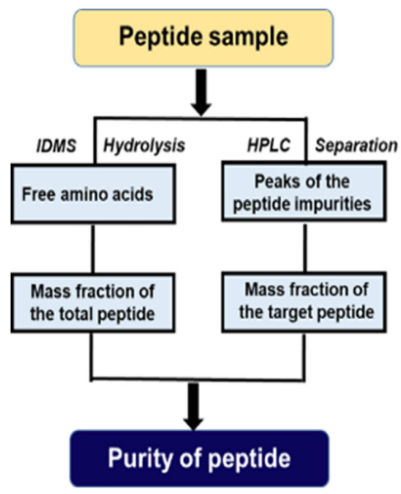
Keeping a high degree of pureness is essential since pollutants can affect bioassays or responses. For instance, truncated peptides or chemically modified side-products could bind to targets or create negative effects that puzzle your outcomes. Specifically customized peptides or cyclic peptide series are tough to validate, which impacts quality control. We integrate LC-MS/MS and enzymatic food digestion evaluation to specifically confirm the series and adjustment websites of non-natural customized peptides. Residual organic solvents, metal ions, or spin-offs from synthesis might cause harmful negative effects.
One of the most strict quality, entailing mindful HPLC filtration-- sometimes numerous rounds-- and rigorous QC. Required for quantitative studies, architectural biology, in vivo research models, and any application where even small amounts of contamination might impact outcomes. This is the grade where the boost most dramatically, because attaining that last 1-- 3% of pureness requires throwing out a substantial fraction of the manufactured material. A removal peptide missing out on a solitary residue may still bind to the same receptor, yet with different fondness or selectivity. In concentration-response experiments, these impurities can change curves, flatten plateaus, or introduce biphasic actions that covers truth activity of the target substance. The isoelectric factor (pI) is a crucial parameter for comprehending peptide solubility and habits in various environments.